← home page • Buzz@Bruss! Edition #5 • Green policies, red flags: the challengesof the EU Sustainable Finance Framework
JTI’s Dr Alona Bekh, outlines the key challenges of the EU Sustainable Finance Framework and argues that the exclusion of the tobacco industry from sustainable activities not only sets a dangerous precedent but will also be counterproductive to the achievement of the EU’s overall sustainability objectives.
Businesses are facing significant bureaucratic challenges as they navigate the EU’s sustainability regulations
Reports, including the Draghi report and “Companies & ESG: Transformation or Just Reporting?”, reveal that unclear guidance, inconsistent standards and intricate legal requirements — such as those under the EU Taxonomy and CSRD — are shifting focus and resources away from meaningful economic transformation. In Germany alone, implementing the CSRD costs businesses approximately
EUR 1.4 billion annually. The excessive compliance demands risk undermining the competitiveness of EU-based companies, especially compared to other regional blocs, while complicating efforts to achieve genuine environmental and social progress.
The risks of exclusion
Within the EU Sustainable Finance Framework, EU regulators seek to categorize the “cultivation and production of tobacco” as “unsustainable activity”. However, this decision is raising significant concerns among stakeholders. It sets a risky precedent for marginalizing lawful industries based on their social perception, rather than on science-driven, evidence-based benchmarks such as those applied to fossil fuel activities under the EU’s environmental criteria. This approach could lead
to excluding other lawful yet socially controversial industries, like plastic production, alcoholic beverage manufacturing, or the production of high-fat and high-sugar foods. This would further shrink the pool of businesses that can benefit from the EU Sustainable Finance Framework …and jeopardize to the ultimate achievement of the Green Deal objectives.
This type of exclusionary policy could lead to wider criticism of the fairness and consistency underpinning the EU’s sustainability criteria. It could also provoke lawful challenges from affected industries, diverting attention and resources away from the overarching goal of fostering a sustainable future. A more collaborative, innovative approach – focused on driving transformation within industries rather than excluding them – is essential to achieving the EU’s sustainability objectives while maintaining economic and social cohesion.
Ensuring an effective sustainability journey
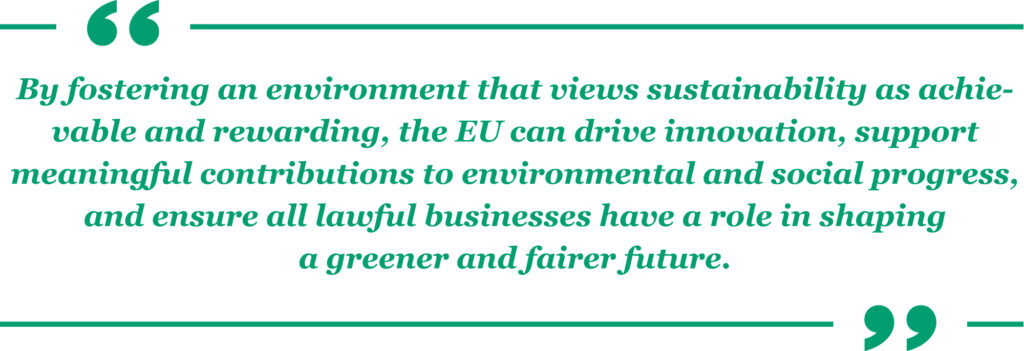
The proposed way forward should highlight inclusivity, fairness and collaboration. Rather than implementing policies focused on exclusions, the EU should prioritize strategies that encourage and reward sustainable practices across all lawful businesses.
This involves providing the tools, incentives and opportunities to help businesses, especially small and medium enterprises, transition to responsible practices.
JTI is committed to investing in innovation and developing a range of reduced-risk products (RRP) — products with the potential to reduce the risks associated with smoking. We have pledged to achieve Carbon Neutrality in our own operations by 2030 and reach Net-Zero across our entire value chain by 2050. Our commitment as a responsible business includes reducing emissions, conserving water, minimizing waste and enhancing biodiversity, all while ensuring that our initiatives positively affect our employees and farming communities. JTI’s commitment to sustainability is also reflected in our dedicated green loan, which was established in 2023 and used to fund initiatives to reduce emissions. These include installing solar panels in Poland, Turkey and Jordan, and using biomass fuel in Malawi. Looking forward, several new projects are in development and are set for rollout in the coming months.