← home page • Buzz@Bruss! Edition #2 • Taking the emotion out of Tobacco Harm Reduction
Chris Woods (CW), JTI Vice President for External Affairs, and Grant O’Connell (GO), JTI RRP Science Vice President sat together to discuss the Company’s approach to Tobacco Harm Reduction and what this can mean for the future development of Reduced-Risk Products.
What does Tobacco Harm Reduction (THR) mean?
CW: Harm reduction itself is a relatively simple concept – it’s principally focused on the reduction of risk of combustible tobacco products and replacing those with something potentially less dangerous.
GO: As an overall concept, it is not new. Harm reduction as a public health strategy is a range of actions, policies and regulations that aim to reduce health risks through providing access to less harmful forms of the products or encouraging less risky behaviors, rather than eliminating the higher-risk behavior itself, recognizing that prohibition leads to unintended consequences. Indeed, there are many such examples in everyday life where many products or activities have been modified to reduce risk. Take road safety. We don’t ban driving, we have speed limits, seatbelts, airbags, etc. We don’t ban people sunbathing, we encourage restraint and provide protective options to reduce health risks.

From JTI’s perspective, we recognize many millions of adult smokers, whilst informed of the risks associated with smoking, including on every pack, enjoy and derive pleasure from smoking and will continue to smoke. Today, there is also growing interest and demand amongst adult smokers for innovative RRPs that have the potential to reduce the health risks associated with smoking tobacco. For those adult smokers who enjoy using tobacco and nicotine, we are seeing that more and more are now choosing to use RRPs as an alternative to continued smoking. This is the basis of Tobacco Harm Reduction or THR.
CW: It’s interesting that the concept of harm reduction, per se, is not a sensitive area – it makes total sense. The concept of tobacco harm reduction, however, is hugely emotional. Some early-adopter countries already put harm reduction into their regulation, others are in the ‘wait-and-see’ category and there are some groups that are just vehemently against the concept of THR and they will never change their minds…irrespective of any existing or future scientific evidence.
Our biggest challenge is to remove emotion from this argument and focus on science, irrespective of who is involved. We’re all legal companies providing legal products, to strict quality standards.
How has the evolution of RRP contributed to THR?
GO: By addressing the diverse and unmet needs of adult smokers and through the elimination of the burning of tobacco, the development of RRPs has allowed us to decouple nicotine from the harmful burnt tobacco smoke. By doing so, RRPs are achieving a significant uptake in the quest for harm reduction that certain Nicotine Replacement Therapies (NRTs), such as the patches and gums that have been around for years, with limited innovation, never have. This has been driven by new technologies and consumer-focused product innovations resulting in a growing number of adult smokers accepting RRPs as an alternative to continued smoking and choosing to use them as a less harmful approach.
CW: Therein lies another key challenge for our industry. We need to have more freedom to communicate that message with our consumers. It’s a key reason why we want to separate the regulatory environment between combustible tobacco products and RRP. A large majority of adult smokers, as well as physicians in certain countries, still believe that nicotine – a product that features on the WHO’s essential medicines list – is the problem in cigarettes or causes lung cancer. This is just a misconception. More studies should be conducted about long-term impacts of RRP, but there needs to be less confrontation about what science can already prove in the short-term.
How does JTI evaluate THR?
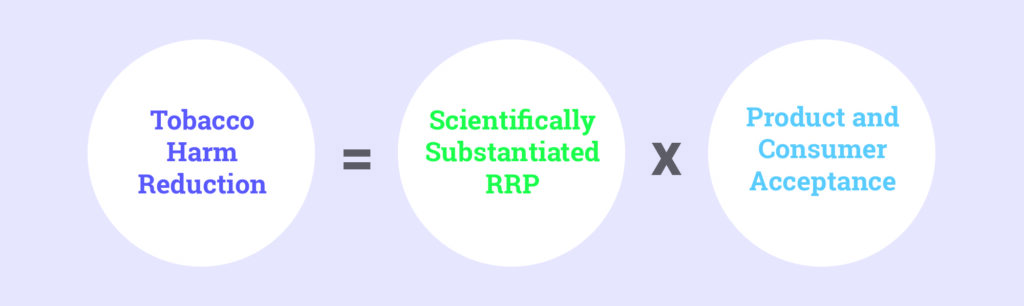
GO: We strongly believe that a science and innovation-based approach to both Product Risk Reduction together with Consumer Acceptance will lead to Harm Reduction outcomes. The two critical components of this formula, the so-called Tobacco Harm Reduction Equation, cannot, however, exist in a vacuum. You can have a product with a significantly reduced risk profile, but if the consumer doesn’t find it a satisfying alternative, then that product stays on the shelf and there is no THR impact.
CW: The key to success in THR lies in finding the balance between meeting the needs and habits of adult smokers and delivering these in a satisfactory, less harmful way. Our consumer-centric approach, understanding consumer needs, habits and values, helps us to deliver this most effectively – there’s an important difference between consumer acceptance and mere product acceptance as a compromise – we have a unique perspective in this respect.
How does science back up the case for THR?
GO: The real premise for RRP comes back to the critical point of burning tobacco or combustion. When you set fire to tobacco that generates a smoke containing nicotine as well as thousands of other chemicals, of which around a hundred are classified as causes or potential causes of disease. When we talk about heating tobacco instead, no smoke is created, and so the aerosol RRP produces contains nicotine alongside fewer and substantially lower levels of harmful chemicals. We’re not saying that this is risk free, but rather that it has the potential to be far, far less risky vs combustible cigarettes.
CW: Science needs to replace emotion. Meanwhile there is a huge, solid body of evidence that vaping or HTP is a harm reduction product vs burning tobacco.
What role does quality play?
GO: It goes without saying that THR needs to be grounded in high quality – quality product materials, quality ingredients, quality manufacturing standards etc. JTI has a quality-centric approach to device safety and ensures careful diligence by professional toxicologists to evaluate the ingredients that go into our consumables…be that heat sticks, e-liquids or pouches.
CW: And of course, quality is an area that also needs to be regulated. We’re looking for more freedoms in the communications side, but we strongly support regulation that would both ensure quality as well as prevent any products being knowingly marketed or appealing to youth.
What specifically do you mean by ‘informed choice’?
CW: We would like to address certain misconceptions and, for example, use science to inform our adult smokers that it is the combustion of tobacco in cigarettes that is harmful rather than the nicotine.
GO: Communicating and ensuring that adult smokers have all the facts so they can make informed decisions and choose what is right for them. The facts are that tobacco is a plant, it contains nicotine, which is classified as an addictive chemical. But it’s not the primary cause of smoking-related diseases. Rather it is the burning of tobacco and inhaling the smoke that is. Innovations in RRP allow us to decouple nicotine from harmful smoke and combustion and thereby offer adult smokers a path to potential reduced risk. Informed choice is also about these products being aligned around adult smokers’ preferences, their values and their needs.
CW: Our consumers are at the heart of JTI’s strategy. They are adult smokers – we don’t tell them what to do, they can make their own decisions. But they do need reliable, evidence-based information upon which to base their choice. Our belief is that a ‘chosen switch’ will be more effective than a ‘forced switch.’